

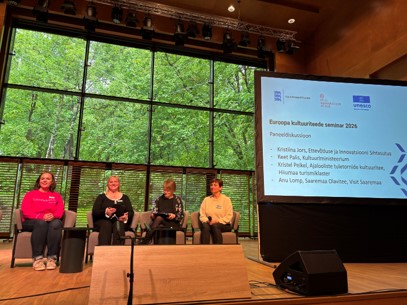
On 22 May, Estonia’s first seminar on European Cultural Routes was held in Tartu, bringing together representatives of established and emerging Cultural Routes in Estonia, researchers, representatives of museums and local authorities, and tourism professionals. The aim of the seminar was to share experiences, introduce different Council of Europe Cultural Routes, and discuss how participation in international networks can help promote Estonia’s cultural heritage and support regional development.
A clear message emerged from the seminar: European Cultural Routes are far more than hiking trails or tourist itineraries. They bring together research, cultural heritage, local communities, entrepreneurship and international cooperation. All the presentations emphasised that Cultural Routes are built through cooperation between people and that their success depends above all on the ability to tell the story of a region in a credible and engaging way.
During the day, several European Cultural Routes and networks in which Estonian partners are already active or have become involved were presented. These included the Hansa Cultural Route, the European Cemeteries Route, the Viking heritage network Destination Viking, the Romea Strata pilgrimage route, and the Route of Singing Heritage, which has recently received certification as a European Cultural Route. Although their themes range from medieval towns and pilgrimage to singing traditions and cemetery heritage, they share a common goal: to make Europe’s shared cultural heritage visible and meaningful to people today.
At the seminar, the St. Olav Foundation presented the development of the Estonian St. Olav Way as part of the wider European cultural landscape associated with St. Olaf. The presentation emphasised that the Estonian St. Olav Way is not merely a new hiking trail, but a research-based cultural project connecting the history of the Baltic Sea region, medieval churches, coastal landscapes and the heritage of local communities. In this way, the route creates new opportunities both for presenting cultural heritage and for supporting sustainable regional development.
Several presentations noted that a Cultural Route cannot be created simply because historical sites exist. Equally important is the ability to connect these places into a coherent story. Some Cultural Routes focus on cities or churches, others on singing traditions or cemeteries, but they all seek to promote understanding of Europe’s shared roots and highlight the role of local communities in preserving this heritage. Particular emphasis was also placed on the contribution of researchers, museums and memory institutions, as a research-based approach gives Cultural Routes both credibility and international value.
Cooperation was another key theme. Successful Cultural Routes generally emerge from the grassroots—from initiatives led by local people, associations and enthusiasts—but their sustainable development requires effective cooperation with local authorities, national institutions, businesses and international partners. It was also emphasised that a Cultural Route is not an end in itself, but a framework for connecting existing cultural assets and making them more visible and accessible to both local residents and visitors.
The seminar confirmed that an active European Cultural Routes community is emerging in Estonia. The different networks do not compete with one another but complement each other, telling different yet interconnected stories of European cultural history. This diversity provides Estonia with an opportunity to engage an international audience interested in culture and to strengthen its place within the shared European cultural landscape.
A video recording of the seminar is available on the Estonian Ministry of Culture’s YouTube channel: European Cultural Routes Seminar 2026 – Opening Remarks
The St. Olav Foundation considers it important that Estonia should be a visible partner in European Cultural Route networks. Cultural Routes help bring together research, the preservation of cultural heritage and initiatives by local communities into a coherent whole, strengthening both Estonia’s international visibility and our understanding of its historical heritage. Developing precisely this kind of cooperation is one of the Foundation’s principal objectives.