

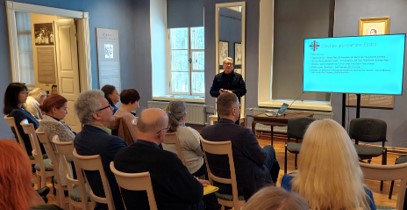
On 26 February, representatives of local authorities, congregations, museums, tourism organisations and communities from Western Estonia gathered at Lihula Manor to discuss the next stages in the development of the Estonian St. Olav Way. The meeting marked an important step in extending the work already begun in Saaremaa to mainland Estonia and reaffirmed the principle that the Estonian St. Olav Way will be developed in cooperation with local communities.
The meeting was opened by Anton Pärn, Director of the Haapsalu and Läänemaa Museums, who emphasised the need to connect sites associated with St. Olaf into a coherent cultural route presenting the shared history of Estonia and Scandinavia. It was also considered important that the new route should complement existing hiking trails rather than duplicate them.
Professor Kersti Markus, a member of the Supervisory Board of the St. Olav Foundation, presented the historical and international concept of the Estonian St. Olav Way. Her presentation addressed the spread of the cult of St. Olaf in the Baltic Sea region, the role of the Estonian coast in connections between Scandinavia and the East, and the principle that the different regional sections of the Estonian St. Olav Way form a coherent historical whole. She also provided an overview of the European Cultural Route network St. Olav Ways, whose Scientific Committee includes a representative of the Foundation.
Anu Lomp, Head of Visit Saaremaa, presented the route-mapping work carried out in Saaremaa and the experience gained from involving local communities. The discussion covered cooperation with landowners, principles of waymarking, the development of services and the role of communities in shaping the future cultural route. The experience gained in Saaremaa will provide an important basis for planning work in the next regions.
During the joint discussion, participants emphasised that the St. Olav Way should be developed under the leadership of the regions themselves. Route planning must take account of the distinctive local cultural heritage, make use of existing trails wherever possible, and involve close cooperation with local authorities, congregations, the Estonian State Forest Management Centre (RMK), landowners, businesses and volunteers. The meeting agreed on the next steps: establishing regional working groups, developing cooperation with RMK and seeking new funding opportunities.
The Lihula meeting was the first joint discussion in which the experience gained in Saaremaa was brought to mainland Estonia. It reinforced the understanding that the Estonian St. Olav Way is not merely a new cultural and pilgrimage route, but a community-based initiative combining the study of cultural heritage, the strengthening of local identity and cooperation between regions.