

Excavations at Saastna enabled archaeologists to establish the outline of the chapel and uncover numerous coins dating from the 15th to the 17th centuries. Human skeletons were excavated to the south of the chapel.
According to archaeologist Heiki Valk, the Saastna chapel was already famous in the Middle Ages as a site of large gatherings held around St. Olaf’s Day. People continued to gather there to celebrate St. Olaf’s Day later, during the period of Swedish rule. “With the spread of Lutheranism, this came to be condemned as a remnant of Catholic-era superstition. The first such reference in church visitation records dates from 1597, and similar reports continue until the beginning of the 18th century. They mention that people gathered here and engaged in widespread superstition,” Valk said, adding that exactly what took place there remains unknown.
“We can see that coins were offered here. There are many small old coins from the 15th, 16th and 17th centuries, as well as a few Russian copper coins dating from after the Great Northern War, although by then the custom was already dying out,” the archaeologist said. “Altogether, we have found more than 400 coins, most of them dating from the 16th and 17th centuries.”
Anton Pärn, director of the Haapsalu and Läänemaa Museums, said that the site must have been an important place of offerings and large gatherings during major feast days. “The size of the chapel alone demonstrates this. It is six metres wide and 16 metres long, making it a small church of about 100 square metres. Considering its building material—stone—it was certainly more important than merely serving as a sanctuary for the inhabitants of what was then a small island. It was also significant for the fishermen of Matsalu Bay. On St. Olaf’s Day, this was an international meeting place where, according to a 16th-century document, people came from Gotland, Saaremaa, Courland and all the surrounding areas,” Pärn explained.
According to Valk, it is clear that the chapel was built of stone. “It may have been plastered. It seems there were no glazed windows, because despite all the sieving we have found remarkably little window glass here. Although one might expect there to have been at least a window at the eastern end,” Valk said. He added that the roof was apparently made of wood or reed. “We have not found a single fragment of a roof tile,” he noted.
On the northern side, archaeologists have excavated a small adjoining room projecting from the main body of the chapel. “There was probably an altar dedicated to the Virgin Mary there. We found many coins and coin pendants,” Valk said.
“The floor was probably laid with thin limestone slabs, about three to four centimetres thick, collected from the shore and fitted together. We have found hundreds of them. We have also found one fragment of carved stone, but that is the only worked limestone object discovered so far,” Pärn said.
The foundation stones of the chapel’s altar have also survived, one of them still in its original position. “The stones are held together by blue clay in the lower courses and very weak mortar higher up. It appears that everything was constructed at the same time. Initially, we thought there might have been several phases of construction, but that still needs further investigation,” Pärn explained.
No one appears to have been buried inside the Saastna chapel itself, although archaeologists have discovered burials to the south of the church. “The burials are relatively late, dating from the 16th and 17th centuries, when the church had already been abandoned,” Valk said. He suggested that the chapel may not have possessed burial rights. “The bishop could grant such rights to a church or chapel, but he did not necessarily do so.”
According to the archaeologists, the stone wall surrounding the chapel could indicate the existence of a cemetery. “However, it may also have marked an area of sanctuary—the area surrounding a sacred building where a fugitive criminal was protected from secular authorities. Once within church territory, the fugitive fell under ecclesiastical jurisdiction,” Valk explained.
“The chapel site was already investigated by scholars in 1930–31 and again later,” Pärn said.
This time, the archaeologists were prompted to excavate the site by the Norwegian-funded project “From Nidaros to Novgorod,” which investigates historic waterways and harbour sites associated with St. Olaf, as well as other places connected with the saint. “One of these is St. Olaf’s Chapel at Saastna. Another is a chapel on the Sõrve Peninsula, off which lies the Olavi shoal. In Virumaa, there is Tarakallas, an ancient hillfort and harbour site. The name of Olaf no longer survives in present-day local oral tradition at Saastna, but it does occur in church visitation records. A 17th-century map also marks a St. Olaf’s field nearby,” Pärn said.
According to the archaeologists, the Saastna chapel was probably dismantled so that its building materials could be reused. They found no charcoal that would indicate destruction by fire. Valk said that the walls had been demolished almost to ground level and the stone removed for use as building material.
Pärn added that the timber was probably also removed for reuse. “Possibly already during the Livonian War,” he suggested.
According to Valk, few comparable chapels are known in Estonia. “Perhaps Saha Chapel, which is very well known because it has survived,” Valk reflected. “But we have not found anything indicating that the Saastna chapel had vaulting—for example, fragments of ribs,” Pärn added.
It is difficult to reconstruct exactly what the chapel once looked like, although Valk said that the archaeological evidence makes it possible to propose several reconstruction alternatives. “Or we could compare it with surviving chapels of the same period that have a similar ground plan,” Pärn said. “It would have had a high triangular gable, like medieval ecclesiastical buildings generally did, with a wooden or reed roof and unglazed windows. A tower? Well, there was a rectangular projection on the western side. Was it a buttress, or perhaps a pillar topped by a statue of St. Olaf? We simply do not know,” Valk said.
The major excavation campaign at Saastna will conclude this summer. “Perhaps next year we will try to clarify a few remaining questions,” Pärn said. “The chapel walls, or at least their course, could be marked out, the area could be landscaped, and information boards should certainly be installed so that the site can be visited.”
According to Pärn, the site has such a rich story and message that there is every reason to come here on the eve of St. Olaf’s Day or on the feast day itself to mark the occasion. Visitors could also see the Näärikivid stones, the manor complex and Porimägi before walking across the field to the chapel site and gaining an impression of the former island of Saastna.
“This area certainly deserves to be restored and maintained,” Pärn said. “The Läänemaa Archaeology Foundation considers precisely this kind of work—interpretation and maintenance—to be one of its responsibilities, and intends to participate when work begins on restoring the area.”
Research at Saastna Chapel
The work at Saastna is part of the project “From Nidaros to Novgorod,” which focuses on the study of maritime routes and harbour sites. The project is supported by Norway and led by Tallinn University, with partners including the University of Tartu and the Haapsalu and Läänemaa Museums Foundation.
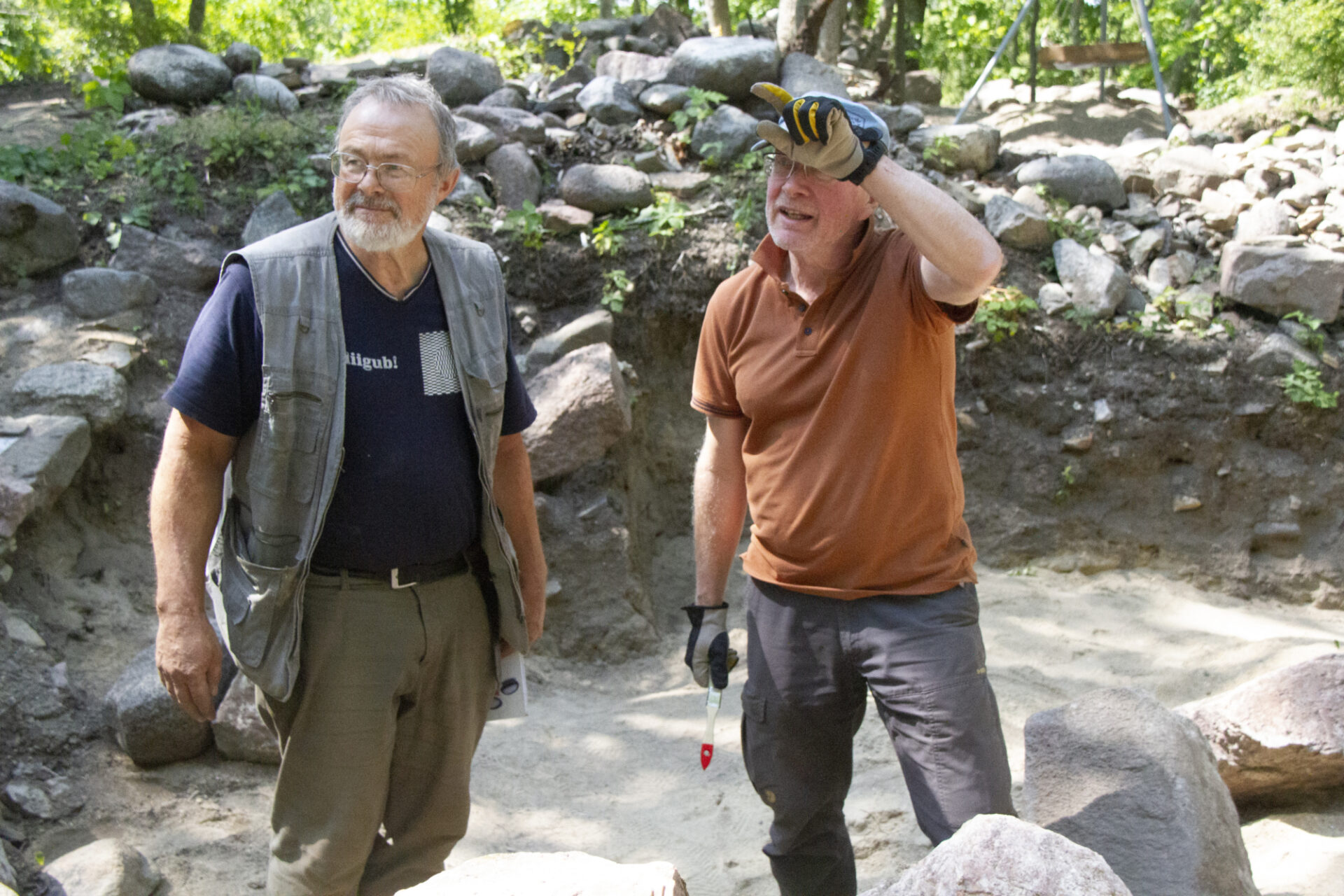
Archaeologists Heiki Valk (left) and Anton Pärn presented the excavations of Saastna Chapel to visitors. Photo: Andra Kirna